 Mahoulolo SEBIO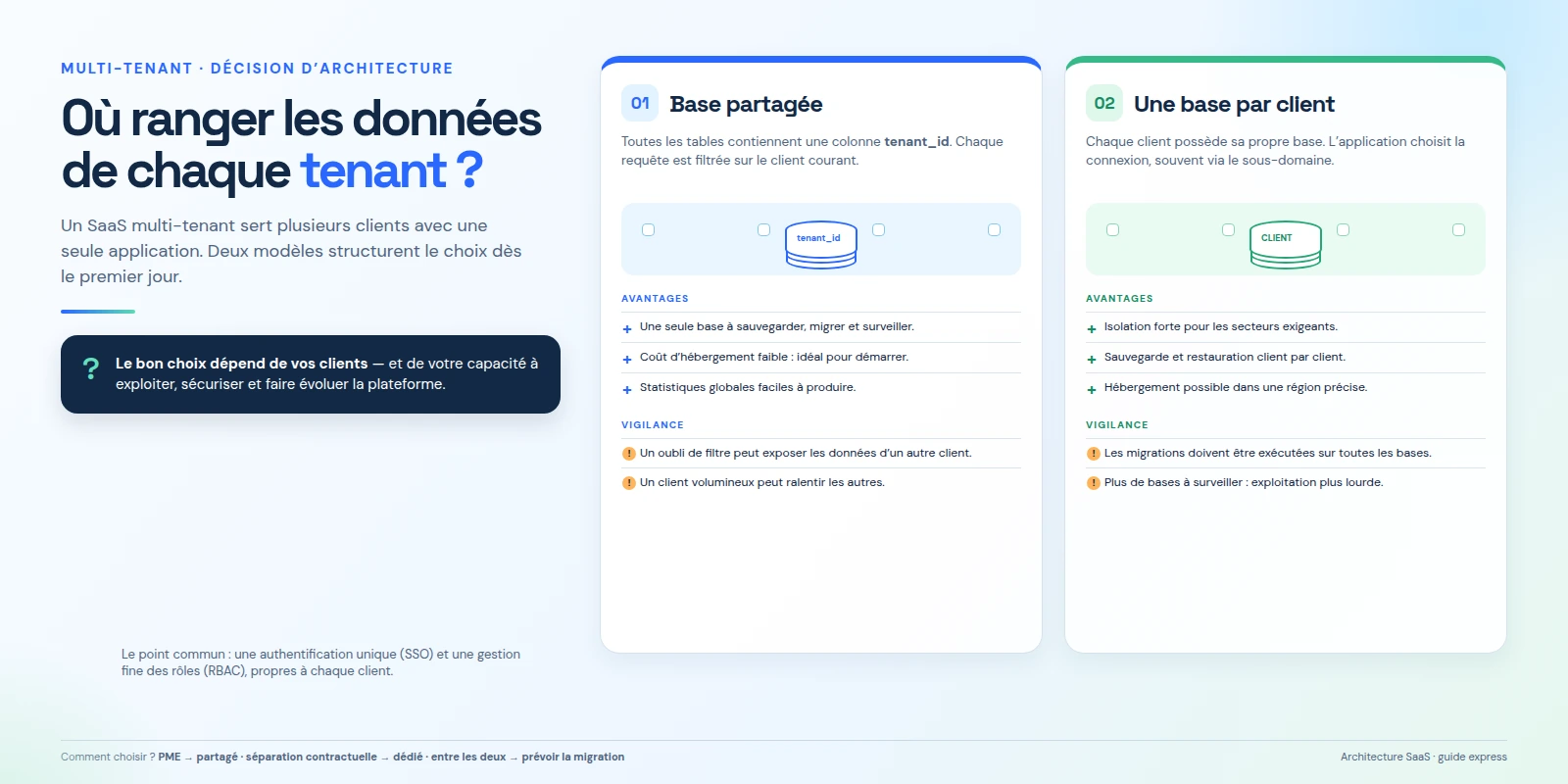
A multi-tenant SaaS serves several customers (the "tenants") with a single application. The question comes up on day one: where should each customer's data live?
Option 1: a shared database
Every table has a tenant_id column and every query is filtered on the current customer. With Laravel, a global scope applied automatically prevents oversights.
protected static function booted(): void
{
    static::addGlobalScope('tenant', function (Builder $query) {
        $query->where('tenant_id', tenant()->id);
    });
}
Pros
- A single database to back up, migrate and monitor.
- Low hosting cost, ideal to get started.
- Global statistics are easy to produce.
Watch out for
- A missing filter can expose another customer's data: tests are essential.
- A very large customer can slow down the others.
Option 2: one database per customer
Each customer gets its own database. The application picks the connection at the start of each request, often from the subdomain.
Pros
- Strong data isolation, valued by demanding customers (health, finance, institutions).
- Backup and restore customer by customer.
- Ability to host a customer in a specific region.
Watch out for
- Migrations must run on every database.
- More databases to monitor, so heavier operations.
How to choose?
- You are starting out and your customers are SMEs: shared database, with solid isolation tests.
- Your customers require contractual data separation: one database per customer.
- In between: start shared, and design a data-access layer from day one that lets you move large customers to a dedicated database.
The common ground: authentication
Whatever you choose, a serious SaaS needs single sign-on (SSO) and fine-grained role management (RBAC) per customer. That is often where the real security of the platform is decided.
The right choice is not the most technically elegant one: it is the one that fits your customers and your ability to operate it.
Designing a SaaS? I can help you lay down a sound architecture from day one.